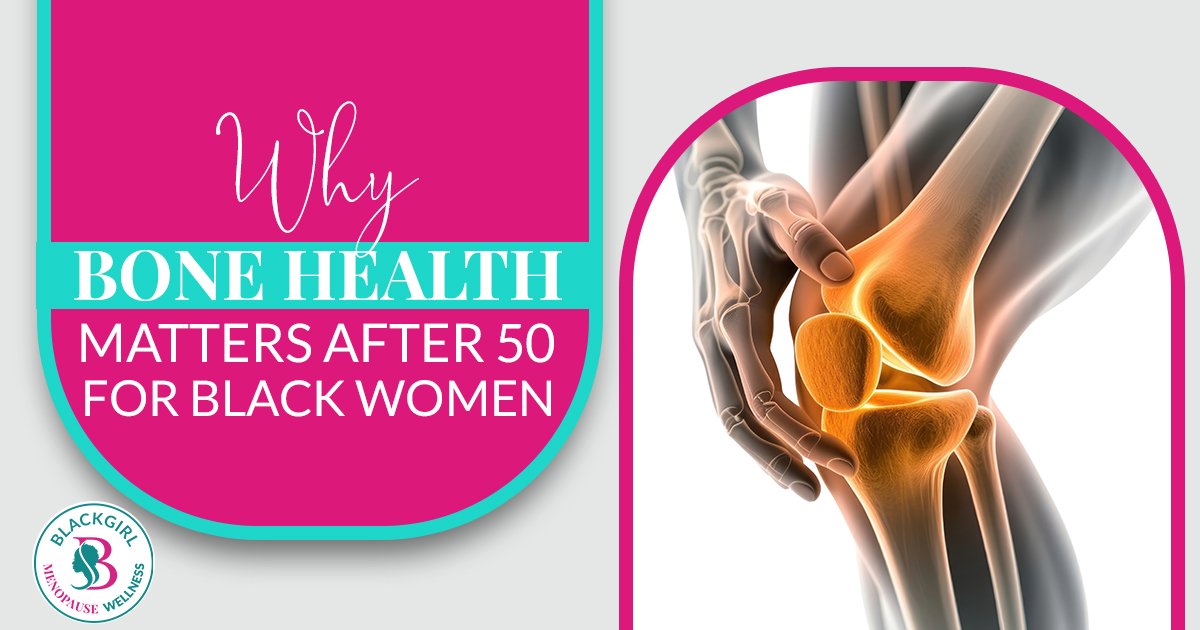
Why Bone Health Matters for Black Women After 50
Share It!
As Black women we often feel strong in our bodies even after fifty. So, we assume that our entire bodies are in perfect shape. After all, our mantra is ‘blacks don’t crack.’ But it appears our bones never got that memo. As we age, it is quietly changing in our bodies, and we don’t often discover it until things go wrong.
While we’re navigating the visible symptoms of menopause as black women, we often miss the silent changes in our bone health that affect our appearance, productivity, daily functions, and overall health.
Most of us only discover it once something bends or breaks, leaving us in unbearable pain and a long road of recovery. But the earlier we discover how our bone health changes in this stage of life and take steps to support it the stronger and healthier we will be long after 50.
So, grab a cup of tea, put your foot up on a hassock as we say in Jamaica and let’s talk about it.
Bone Health Statistics for Black Women at a Glance
Let’s begin with some facts that might surprise you.
Did you know? About 1-in-5 women over 50 in the United States have osteoporosis, while more than 50% of women in this age range have low bone mass, which is the stage before osteoporosis [1] . According to statistics, only 6.8% of Black adults over 50 have osteoporosis, compared to 12.9% of White adults[2] . Due to this disparity, Black women have been overlooked in screening and diagnosis for osteoporosis. A Black woman is 40% less likely to have a bone density scan compared to White women, even when we meet the screening criteria [3] . We also have a higher risk of mortality after a major osteoporotic fracture [4]. Read that as many times as you need to.
To live our best lives in our 50s and beyond, we need to understand the changes happening in our bones and stay healthy to prevent common fractures caused by osteoporosis such as hip, spine, and wrist fractures, especially spinal fractures, which often lead to height loss, stooped posture, and chronic pain [5].
The Silent Change Happening Within: Aging and Other Factors
Here are some things happening within our bodies that are quietly affecting our bone health.
- Aging: Bone mass in females peaks around age 30, after which bone thinning begins each year and speeds up significantly during and after menopause [6].
- Reduced Estrogen: Estrogen, a hormone that protects bones, sharply decreases post-menopause, which studies have proven can cause bone loss [7]. Research shows that bone loss at the spine occurs faster and earlier than in many other areas during the transition to menopause [8].
- Chronic Stress: Many Black women live with chronic stress due to harsh life conditions, generational trauma, and systemic disparities, which is why stress management is crucial. Chronic psychological stress has been linked to thinner, weaker bones [9], while higher social stress is linked to lower bone density in postmenopausal women [10]. This makes all sorts of stress management very important for women over 50.
- Sedentary Lifestyle: Most of us juggle multiple roles while overlooking our own needs. With so many tasks to carry out in our families, professional, and personal lives, exercise often feels like a luxury. Then, as we age, most women become less physically active, often assuming that they need rest over movement, which is far from the truth. Endurance, strength, and balance exercises can actually help bones in postmenopausal women become stronger [11] [12].
- Unhealthy Diet: Research shows that the diets of most adults in North America are short of calcium, vitamin D, vitamin K, and magnesium, which support healthy bones [13].
Signs of bone health risks
Although bone health changes happen within, they leave external signs that we can monitor. If you experience one or more of these signs, your bone health probably needs a second look.
- Dental changes: If you’ve noticed loosening teeth or gum disease, you should talk to your dentist about how it might be linked to your bone health. 10 out of 15 studies have linked gum disease with osteoporosis [14].
- Height changes: Studies found that a loss of about 1.7 inches (4.5 cm) from heights of women above 60 was connected to existing spine fracture [15]. Measure and monitor your height so you don’t miss any changes.
- Weaker grip: If you’ve noticed weaker grip post menopause compared to pre menopause, it is worth a second look. Studies have identified strong hand grip as a predictor of bone mineral density in adults above 40 years [16].
- Back pain: ordinary activities such as bending or lifting can cause a vertebra crack and intense pain, which we often blame on age. However, research proves that between two-thirds and three-quarters of spine fractures are not clinically recognised, leading to a misattribution of the cause [17]. So, don’t brush off that backache, especially if it is recurring.
- Digestive issues: Digestive conditions such as inflammatory bowel disease and celiac disease can interfere with the absorption of vitamin D and calcium, thereby causing bone loss [18]. If you experience recurring digestive issues, speak to your doctor about the possible impact on your bones.
- Nail Changes: Yes, even your nails can tell when something is wrong. Women over 50 often deal with brittle, splitting nails, which can be attributed to many factors, including exposure to extreme temperatures, acrylic nails, or diet. However, declining nail strength and slow nail growth have also been linked to osteoporosis [19], which means nail changes deserve a second look.
What to do About it
The good news is we’re not helpless. You can control how your bone health turns out.
- Pay attention and keep a log: Start taking notes of height changes, back pain, dental changes, weakening grip, nail changes, and digestive symptoms. If you spot any patterns, note them down and discuss what you have observed with a doctor.
- Ask about screening and get checked: if you’re a postmenopausal Black woman over 50, ask your doctor if a bone density (DXA) screening is right for you. The preventive task force in the U.S. recommends bone density screening for women 65 and older, and for postmenopausal women under 65 who face a high risk of osteoporosis [20].
- Make lifestyle changes that supports strong bones. Check out this article – 6 Ways to build Healthier & Stronger Bones in Menopause.
With love and health,
Charmaine
Disclaimer
The information presented here is for informational and educational purposes only and is not intended to be used as medical advice. Any statements or claims about the possible health benefits conferred by any products or lifestyle changes have not been evaluated by medical professionals or the Food & Drug Administration and are not intended to diagnose, treat, cure, or prevent any disease. You should consult your health practitioner before changing your diet, taking supplements, or starting any exercise or health program.
References
- Sarafrazi N, Wambogo EA, Shepherd JA. Osteoporosis or low bone mass in older adults: United States, 2017–2018. NCHS Data Brief, no 405. Hyattsville, MD: National Center for Health Statistics. 2021. DOI: https://dx.doi.org/10.15620/cdc:103477
- QuickStats: Percentage of Adults Aged ≥50 Years with Osteoporosis, by Race and Hispanic Origin — United States, 2017–2018. MMWR Morb Mortal Wkly Rep 2021;70:731. DOI: http://dx.doi.org/10.15585/mmwr.mm7019a5
- Miller, R. G., Ashar, B. H., Cohen, J., Camp, M., Coombs, C., Johnson, E., & Schneyer, C. R. (2005). Disparities in osteoporosis screening between at-risk African-American and white women. Journal of general internal medicine, 20(9), 847–851. https://doi.org/10.1111/j.1525-1497.2005.0157.x
- Juels, M., Larson, J. C., Ensrud, K. E., Stefanick, M. L., Shadyab, A. H., Garcia, L., Nassir, R., Schnatz, P. F., Nelson, R., & Crandall, C. J. (2025). Race, Ethnicity, and Mortality Following Major Osteoporotic Fracture: Results from the Women’s Health Initiative Study. Journal of general internal medicine, 40(11), 2583–2592. https://doi.org/10.1007/s11606-025-09506-6
- NHS INFORM. Osteoporosis. https://www.nhsinform.scot/illnesses-and-conditions/muscle-bone-and-joints/conditions-that-can-affect-multiple-parts-of-the-body/osteoporosis/
- Fatima, S., Talha, M., Abrar, M., & Shaid, F. (2025). Menopausal Status-Dependent Alterations in Bone Mineral Density in Women Transitioning from Menopause to Postmenopause: An Observational Multicenter Study. Sage open aging, 11, 30495334251345095. https://doi.org/10.1177/30495334251345095
- Shieh, A., Greendale, G.A., Cauley, J.A., Karvonen‐Gutierrez, C., Crandall, C.J., Karlamangla, A.S (2019) Estradiol and Follicle‐Stimulating Hormone as Predictors of Onset of Menopause Transition‐Related Bone Loss in Pre‐ and Perimenopausal Women, Journal of Bone and Mineral Research, Volume 34, Issue 12, Pages 2246–2253, https://doi.org/10.1002/jbmr.3856
- Shieh, A., Karlamangla, A.S, Huang, M-H., Han, W., Greendale, G.A. (2021) Faster Lumbar Spine Bone Loss in Midlife Predicts Subsequent Fracture Independent of Starting Bone Mineral Density, The Journal of Clinical Endocrinology & Metabolism, Volume 106, Issue 7, Pages e2491–e2501, https://doi.org/10.1210/clinem/dgab279
- Azuma K, Adachi Y, Hayashi H, Kubo K. Chronic Psychological Stress as a Risk Factor of Osteoporosis, Journal of UOEH, 2015, Volume 37, Issue 4, Pages 245-253, Released on J-STAGE December 13, 2015, Online ISSN 2187-2864, Print ISSN 0387-821X, https://doi.org/10.7888/juoeh.37.245,
- Follis SL, Bea J, Klimentidis Y, et alPsychosocial stress and bone loss among postmenopausal women: results from the Women’s Health Initiative J Epidemiol Community Health 2019;73:888-892. https://www.jstor.org/stable/e26896501
- Greendale G, Jackson N, Shieh A et al. Leisure time physical activity and bone mineral density preservation during the menopause transition and postmenopause: a longitudinal cohort analysis from the Study of Women’s Health Across the Nation (SWAN) The Lancet Regional Health – Americas, 2023; 21. https://doi.org/10.1016/j.lana.2023.100481
- Mishra, N., Mishra, V. N., & Devanshi (2011). Exercise beyond menopause: Dos and Don’ts. Journal of mid-life health, 2(2), 51–56. https://doi.org/10.4103/0976-7800.92524
- Price, C. T., Langford, J. R., & Liporace, F. A. (2012). Essential Nutrients for Bone Health and a Review of their Availability in the Average North American Diet. The open orthopaedics journal, 6, 143–149. https://doi.org/10.2174/1874325001206010143
- Goyal, L., Goyal, T., & Gupta, N. (2017). Osteoporosis and Periodontitis in Postmenopausal Women: A Systematic Review. Journal of Mid-life Health, 8(4), 151–158. https://doi.org/10.4103/jmh.JMH_55_17
- Karine Briot Erik Legrand Denis Pouchain Stéphanie Monnier and Christian Roux CMAJ April 06, 2010 182 (6) 558-562; DOI: https://doi.org/10.1503/cmaj.090710
- Wu, N., Li, X., Mu, S., Fu, Q., & Ba, G. (2021). Handgrip strength is positively associated with bone mineral density in middle and aged adults: results from NHANES 2013-2014. Archives of osteoporosis, 16(1), 121. https://doi.org/10.1007/s11657-021-00938-1
- Fink, H. A., Milavetz, D. L., Palermo, L., Nevitt, M. C., Cauley, J. A., Genant, H. K., Black, D. M., Ensrud, K. E., & Fracture Intervention Trial Research Group (2005). What proportion of incident radiographic vertebral deformities is clinically diagnosed and vice versa?. Journal of bone and mineral research : the official journal of the American Society for Bone and Mineral Research, 20(7), 1216–1222. https://doi.org/10.1359/JBMR.050314
- Katz, S., & Weinerman, S. (2010). Osteoporosis and gastrointestinal disease. Gastroenterology & hepatology, 6(8), 506–517. https://pubmed.ncbi.nlm.nih.gov/20978554/
- Pillay, I., Lyons, D., German, M. J., Lawson, N. S., Pollock, H. M., Saunders, J., Chowdhury, S., Moran, P., & Towler, M. R. (2005). The use of fingernails as a means of assessing bone health: a pilot study. Journal of women’s health (2002), 14(4), 339–344. https://doi.org/10.1089/jwh.2005.14.339
Share It!
Related Posts
Hey there,
Charmaine here

Follow Me