
Heart Health And Black Women. Why You Should Care in Menopause
Share It!
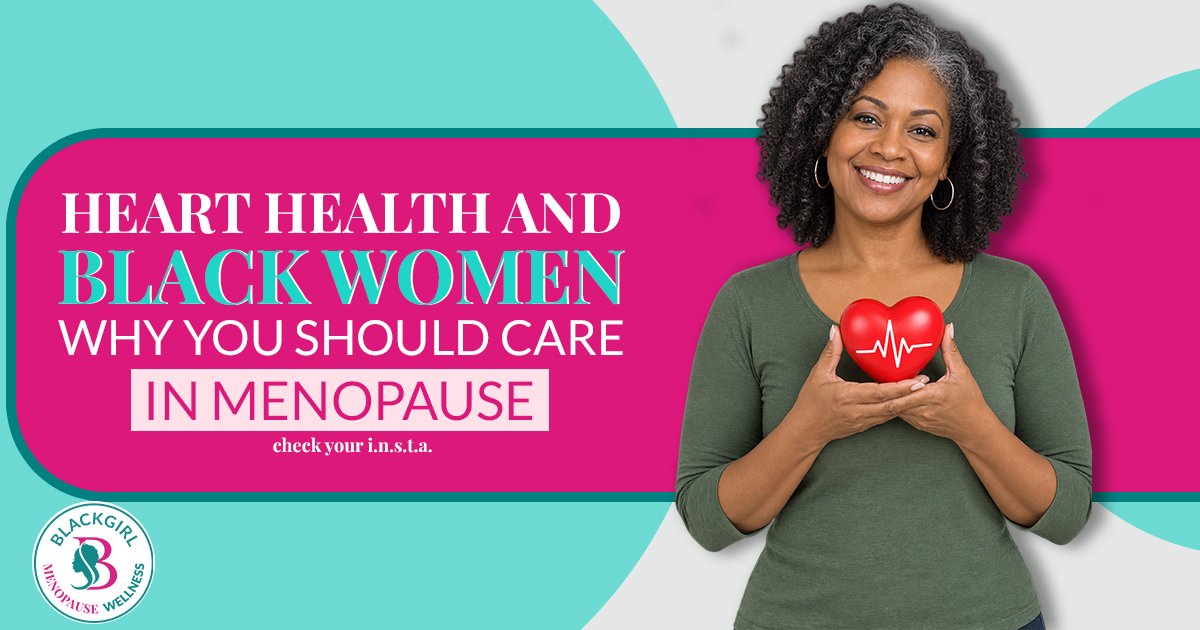
By the time menopause has changed your sleep, energy, or how you feel in your body, heart health may be lower on your list of concerns. Instead, you are busy at work trying to breathe through a hot flash, or lying in bed asking yourself, “Why am I awake in the middle of the night again at 3 a.m.,” or worried that your lack of desire for intimacy is pulling you towards a divorce.
The last thing on your mind might be your heart. Why should you be concerned about it? And that is exactly why I am writing this: you should be. It needs to be part of your health conversation now. Here’s why.
Cardiovascular disease is the leading cause of death among women in the U.S., and Black women face a higher risk than most¹. I am not sharing this information to make you anxious. Instead, I want to impress upon you that, starting now, you need to take your heart health seriously.
How does menopause relate to your heart?
More than you might expect.
Most of us know estrogen is closely related to our periods, hot flashes, and other menopause symptoms. However, it also helps to keep your blood vessels healthy and affects how your body processes cholesterol.
As estrogen levels decrease during the menopause transition, LDL cholesterol, sometimes called “bad” cholesterol, increases. Body fat and blood vessels also change during the menopause². A study that followed women through the menopause transition found increases in total cholesterol and LDL cholesterol around the final menstrual period³.
Naturally, menopause is not the only thing going on. Many of your bodily systems are now aging, and that, too, affects blood pressure, blood sugar, metabolism, sleep, and activity.
Why should Black women pay particular attention?
For many Black women, menopause may be adding to risks that were already there.
High blood pressure is one clear example. Black women are nearly 60% more likely to have high blood pressure than other groups of women⁴.
But it would be much too simple-and wrong-to make this just about biology, especially for us Black women.
Our heart health is also shaped by the life we have lived. Social and structural factors like access to quality preventive care, income, chronic and toxic stress, discrimination, local environment, and lack of awareness may have a significant impact on cardiovascular health. The American Heart Association has identified some of these factors as a key driver of racial disparities in heart health¹.
That voice inside you is trying to tell you something
One problem with heart issues is that we have been given a very dramatic picture of what it is supposed to look like: someone suddenly clutching their chest and collapsing.
Real life is not always that obvious.
Research suggests you may have shortness of breath, feel lightheaded, nauseous, or tired for no reason; sweat; experience pain or discomfort in your back, neck, jaw, or stomach; or feel indigestion⁴.
Some symptoms can even be easier to dismiss during menopause. Exhaustion could come from a poor night’s sleep, and feeling out of breath might make you think you need more exercise.
Not all cases of tiredness or breathlessness signal a heart attack. But anything that is new, severe, ongoing, or doesn’t feel right should always get medically checked.
And then there are the ones that warn you less.
Both high blood pressure and high cholesterol are asymptomatic. It is possible not to experience any symptoms at all while either is silently boosting your heart disease risk.
Start with what you can actually do
You don’t have to feel overwhelmed by this. First, start with an appointment.
Ask what your blood pressure is. Get your cholesterol checked. Ask if you need a blood test to check your blood sugar. If you are already taking medication for high blood pressure, diabetes, or high cholesterol, ask your doctor what these numbers mean and if your medication is working to keep them at healthy levels⁵.
Next, review your diet, the types, quality, and quantities of foods and nutrients you consume most of the time.
You don’t need expensive powders, supplements, or “superfoods” to improve your heart health. And a heart-healthy way of eating doesn’t have to be complicated or exotic. Just more vegetables and fruit, beans, whole grains, nuts, fish, and other lean proteins, and fewer ultra-processed foods, sugar-sweetened beverages, high-sodium foods, and foods with lots of saturated fat⁵.
Aerobic exercise particularly helps cardiovascular fitness—brisk walking, swimming, cycling, or dancing all count. Adults are generally advised to aim for around 150 minutes of moderate aerobic activity each week⁶.
But if you have not been exercising, forget the perfect target for a moment. Start with a 10- or 15-minute walk. Your starting point does not have to look impressive to be worthwhile.
Say no to stressors – tell it to ‘talk to the hand’
“Say no to Stressors” can seem like useless advice when you have stressors that aren’t going anywhere, especially for us who are often carrying so much from our past and overdoing it in our day-to-day lives.
It might not always be easy to eliminate the pressures of work, family obligations, financial concerns, and everything else that demands your time. You can start by setting boundaries and taking breaks from mental and physical tension. A simple start is to turn off your phone and electronics at a specific time, or take a 10-minute break from activities each hour or every other hour.
Another simple solution: slow breathing. Take five minutes to breathe slowly and deliberately, perhaps right before you get out of bed, in the middle of a tough afternoon, or as you settle in to sleep. Slow breathing relaxes the nervous system and may also reduce blood pressure⁷.
Know the heart history in your family
Ask questions when you talk with your family.
Did mom have high blood pressure? Did dad have a heart attack? Did any of our family members have a stroke? Did any of these issues occur at a fairly young age?
Family history gives your healthcare provider insight into your risk for cardiovascular disease. Your pregnancy history is also important, even though it is long gone. Bring up any history of high blood pressure or diabetes during your pregnancies in your discussions about heart health⁴.
Today, do one thing for your heart and for yourself.
So don’t start your Day with the load.
Make it about one thing.
Test your blood pressure. Or. Make the appointment you keep canceling. Or. Walk before dinner.
Your heart doesn’t require perfection. It simply requires your attention.
With love and health,
Charmaine
Disclaimer
The information presented here is for informational and educational purposes only and is not intended to be used as medical advice. Any statements or claims about the possible health benefits conferred by any products or lifestyle changes have not been evaluated by medical professionals or the Food & Drug Administration and are not intended to diagnose, treat, cure, or prevent any disease. You should consult your health practitioner before changing your diet, taking supplements, or starting any exercise or health program.
References
- Mehta LS, Velarde GP, Lewey J, et al. Cardiovascular disease risk factors in women: The impact of race and ethnicity: A scientific statement from the American Heart Association. Circulation. 2023;147(19):1471-1487. doi:10.1161/CIR.0000000000001139. https://pmc.ncbi.nlm.nih.gov/articles/PMC11196122/
- El Khoudary SR, Aggarwal B, Beckie TM, et al. Menopause transition and cardiovascular disease risk: Implications for timing of early prevention: A scientific statement from the American Heart Association. Circulation. 2020;142(25). doi:10.1161/CIR.0000000000000912. https://professional.heart.org/en/science-news/menopause-transition-and-cardiovascular-disease-risk-implications-for-timing-of-early-prevention
- Matthews KA, Crawford SL, Chae CU, et al. Are changes in cardiovascular disease risk factors in midlife women due to chronological aging or to the menopausal transition? Journal of the American College of Cardiology. 2009;54(25):2366-2373. doi:10.1016/j.jacc.2009.10.009. https://pubmed.ncbi.nlm.nih.gov/20082925/
- Centers for Disease Control and Prevention. About Women and Heart Disease. Updated May 15, 2024. https://www.cdc.gov/heart-disease/about/women-and-heart-disease.html
- American Heart Association. Life’s Essential 8. https://www.heart.org/en/healthy-living/healthy-lifestyle/lifes-essential-8
- American Heart Association. Life’s Essential 8: How to Be More Active. https://www.heart.org/en/healthy-living/healthy-lifestyle/lifes-essential-8/how-to-be-more-active-fact-sheet
- American Heart Association. Stress Management. https://www.heart.org/en/healthy-living/healthy-lifestyle/stress-management
Share It!
Related Posts
Hey there,
Charmaine here

Follow Me