
Hot Flashes and Menopause | Why Black Women Are More Affected
Share It!
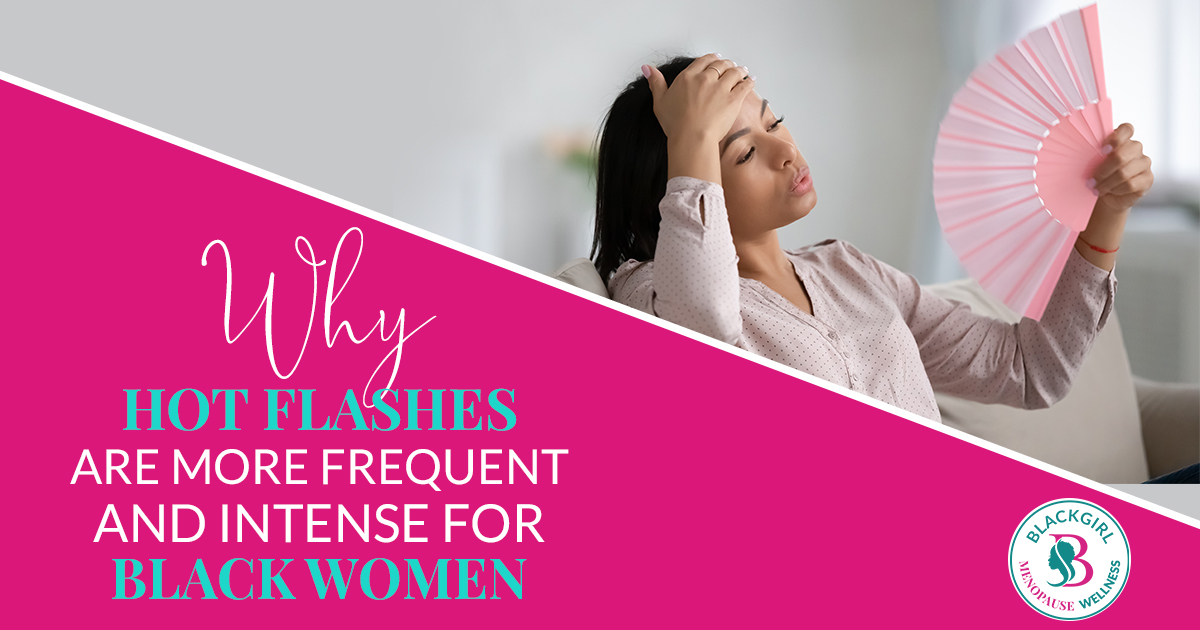
You feel it, and you see it. Hot flashes and night sweats not only trigger heat and sweating, but also frustration. You often feel like you cannot stop them.
If you are asking yourself: Why do my hot flashes feel so intense? What can I do?
Those questions matter, and they deserve clear, caring answers. This blog is a conversation about why hot flashes happen. It explores how biology, stress, culture, and healthcare experiences intersect inside the body. Most of all, it speaks to the lived experience of Black women who are overwhelmed, wonder why it feels so heavy, and are searching for solutions.
Hot Flashes, Night Sweats and Black Women
Hot flashes are common during menopause. About 60 to 80 percent of women experience them at some point¹. Yet research shows that Black women tend to experience hot flashes more often with greater intensity and for a longer period of time than women from other racial groups¹ ² ⁵. Night sweats also appear more frequently which affects sleep and energy levels. In long-term menopause studies that follow women for years one pattern stands out clearly. Black women report stronger hot flashes more frequent episodes and symptoms that last longer into midlife and beyond ¹ ⁵ 6.
This pattern appears across different regions income levels and study designs. It shows that whether researchers look at early menopause late menopause or years after periods have stopped hot flashes can persist well into postmenopause even into the 60s⁷. When symptoms stretch across years the impact on health and quality of life grows.
Sleep disruption accumulates. Energy thins. Focus becomes harder to hold. The body stays on alert. And health issues can surface. If you feel worn down by the heat understanding what is driving it is your first step toward finding relief.
Three Factors Turn up The Heat Internally
#1. Your Internal Temperature Control Becomes Sensitive
Estrogen plays a role in the brain’s thermoregulation system. This intricate process is a delicate dance among your hypothalamus, skin, sweat glands, and blood vessels, all working together to keep you cool when it’s hot or cold. As estrogen levels change during menopause, that control center becomes more sensitive. Small shifts in body temperature can trigger a distress signal to your blood vessels to expand (vasodilation), pushing heat to your skin’s surface, and triggering sweat glands to cool you down – and you experience a hot flash⁵.
Since the face, neck, chest, and upper back are packed with blood vessels and sweat glands, when a hot flash occurs, these areas feel the heat and sweat most intensely.
#2. Being Overweight Makes the Heat Stagnant
The body responds to how heat moves through tissue and how hormones circulate. For example, fat tissue affects how heat is stored and released. It also influences how estrogen is processed in the body. Research shows that higher body weight is linked to more frequent and more intense hot flashes⁴ ⁸. Many Black women experience weight changes during midlife, shaped by genetics, environment, access to healthy food, stress, and daily demands.
Though hot flashes can feel like an attack, it is important to remember that they reflect both physiology and lifestyle, which you can change.
#3. Toxic Stress Keeps the Heat on High
One of the main reasons why hot flashes are often more overwhelming for Black women is often due to the relationship with stress that is often deeply tied to our past, who we are, and wearing the Black Superwoman cape —something I realize I, too, was impacted by.
Understanding how stress shows up for Black women can remove blame and bring clarity.
Stress activates the nervous system. It raises heart rate, tightens muscles, and prepares the body to respond. When stress becomes chronic, the nervous system stays on high alert. The reproductive hormone changes in menopause make it harder for the body to cope with stress, so stressful feelings remain longer instead of the body feeling relaxed. During menopause, this heightened state amplifies hot flashes².
Many of us Black women carry toxic stress coming from held trauma of our enslaved ancestors, societal discrimination, and operating as the ‘Black Superwoman‘. Modern survival demands juggling numerous roles and responsibilities and keeping the foot on the gas pedal to do more, be more, go faster, believing we can do it all, where stress becomes long-term and deadly.
|Check out this post and read more on the Black Superwoman Syndrome|
Getting the job done no matter what, pushing through might appear as resilience, perseverance, and the ability to keep moving forward. Yet what was normalized as strength when we were younger can now become a detriment. When the nervous system stays activated, hot flashes grow louder and more frequent.
Stress effects can also stem from personal and observed discrimination, be it our skin color, hair, etc. Studies show that discrimination leads to more severe vasomotor symptoms, including hot flashes and night sweats². The body holds stress, even when the mind learns to push through.
If you feel your hot flashes are controlling you, take a look at the stress you carry, as it will begin to explain a lot.
The Impact of Hot Flashes on Health and Quality of Life
Hot flashes influence far more than body temperature. Frequent episodes disrupt sleep, leading to fatigue and mood changes⁵. Concentration becomes harder to sustain. Daily responsibilities feel heavier. Emotional resilience thins.
Over time, persistent hot flashes also connect to broader health concerns. Studies show that long-lasting vasomotor symptoms are associated with a higher risk of heart disease and metabolic changes⁵, ⁶. These symptoms indicate how the body is adapting to hormonal shifts.
When hot flashes are frequent and intense, they deserve attention. They reflect how the nervous, cardiovascular, and endocrine systems interact during menopause.
Relief Lies in Recognizing Your Triggers and Cooling Down
Research shows a different story. For many, especially Black women, symptoms continue years after the final menstrual period⁷. When I was in the early stage of perimenopause, I began to experience hot flashes. In trying to find relief, I started to track my episodes to identify triggers, but, more importantly, balance my hormones and make effective lifestyle changes, and my hot flashes stopped. I am now in postmenopause and still keep them away.
What Helps: Understanding personal triggers is the start; room or outdoor temperature, your negative or worrisome thoughts, your tight or heavy clothing, spicy foods, caffeine, hair on the back of your neck, sitting over bright lights, hot foods, being overly excited, sitting for long periods, or being overweight.
Lifestyle changes are essential. Stress reduction is lifesaving. And herbal treatment and hormone replacement are also part of the relief protocol.
Though it can feel as if hot flashes define this phase, understanding reshapes it. Empowerment becomes part of your strength.
You might be interested in the following.
THE ESSENTIAL HOT FLASH RELIEF GUIDE: Do You Want to STOP Your Annoying Hot Flashes?
If you are looking to stop hot flashes in their tracks, finally, and feel like yourself again, check out my eBook, The Essential Hot Flash Relief Guide. The truth is, no single pill or change will create lasting hot-flash relief; it needs whole-body support. You need to know what that looks like, you need to know the evidence-based tools that really works. Click on the link below and make hot flashes a thing of the past.
With love and health,
Charmaine
Disclaimer
The information presented here is for informational and educational purposes only and is not intended to be used as medical advice. Any statements or claims about the possible health benefits conferred by any products or lifestyle changes have not been evaluated by medical professionals or the Food & Drug Administration and are not intended to diagnose, treat, cure, or prevent any disease. You should consult your health practitioner before changing your diet, taking supplements, or starting any exercise or health program.
References
- Miller SR, Gallicchio L, Lewis LM, et al. Association between race and hot flashes in midlife women. Menopause, 2006. https://pubmed.ncbi.nlm.nih.gov/16423474/
- Reeves AN, Lewis TT, Hood MM, et al. Does everyday discrimination account for the increased risk of vasomotor symptoms in Black women? Menopause, 2024. https://pubmed.ncbi.nlm.nih.gov/38595299/
- Grisso JA, Freeman EW, Berlin J, et al. Racial differences in menopause information and symptom reporting. Journal of Women’s Health, 1999. https://pubmed.ncbi.nlm.nih.gov/10051780/
- Appling S, Paez K, Allen J. Ethnicity and vasomotor symptoms in postmenopausal women. Journal of Women’s Health, 2007. https://pubmed.ncbi.nlm.nih.gov/17937565/
- Thurston RC, Joffe H. Vasomotor symptoms and menopause: findings from the Study of Women’s Health Across the Nation (SWAN). Obstetrics & Gynecology Clinics of North America, 2011. https://pubmed.ncbi.nlm.nih.gov/21961716/
- Gold EB, Colvin A, Avis N, et al. Longitudinal analysis of vasomotor symptoms and race/ethnicity across the menopausal transition. American Journal of Public Health, 2006. https://pubmed.ncbi.nlm.nih.gov/16809506/
- Avis NE, Crawford SL, Greendale G, et al. Duration of menopausal vasomotor symptoms over the menopause transition. JAMA Internal Medicine, 2015. https://pubmed.ncbi.nlm.nih.gov/25594776/
- Greendale GA, Gold EB, et al. Lifestyle and demographic factors in relation to vasomotor symptoms. American Journal of Epidemiology, 2004. https://pubmed.ncbi.nlm.nih.gov/15191936/
- Racial differences in menopause treatment and symptom management. National Institutes of Health, 2022. https://pmc.ncbi.nlm.nih.gov/articles/PMC9884100/


Follow Me